
Mapping the Matrix
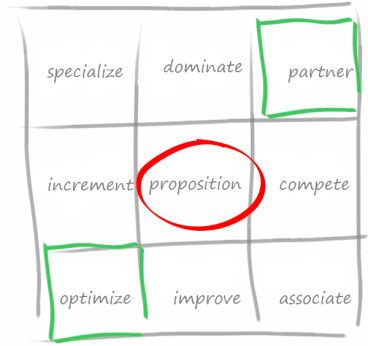 Behind every business is a proposition, you are offering value, a benefit for a price.
We can regard the strategy a company is pursuing as the behavior it has adopted both for its internal operation and how it relates to the outside world.
The strategy is the guideline for your decision making. Typical strategies often used are classified as “competitive”, “user centric”, “growth” etc.. These tend to be the public statements often made and often seen as positive. They need to be balanced with more negative ones which also have to be taken into account e.g. “exit”, “dominant” etc. These are not so prominent, or if lucky they will be discussed in the Company’s Annual Report to the Shareholders.
Here we take the pragmatic view that strategies can three key types, the best are….
‘optimizing‘ or internally focused on being ever better, this is key to making sure your offer is the cheapest, most reliable.
‘proposition‘ with a focus on delivering the benefits to your consumer. this is the focus on the usability of your offer and removing all obstacles to using your proposition.
‘partners‘ the skill to work with other companies and industries to deliver new propositions.
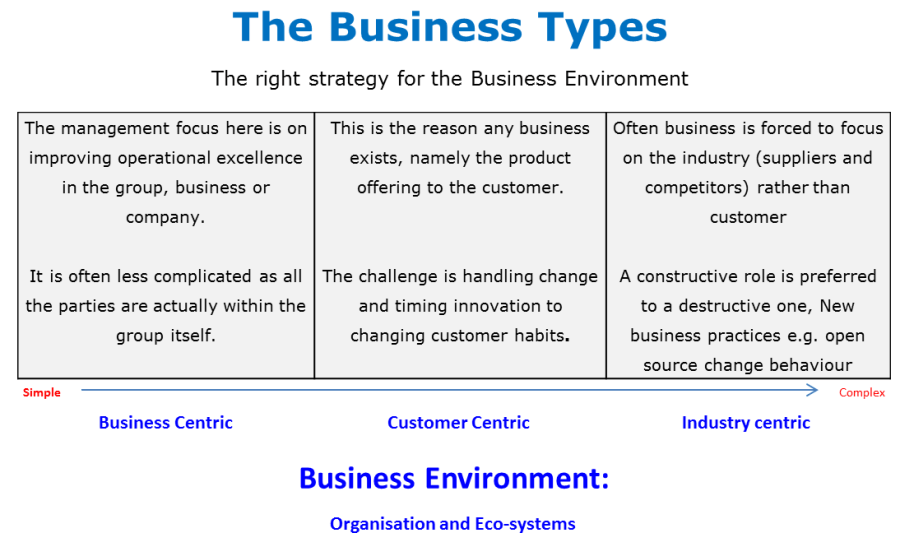
The Business Types:
Business Centric – Customer Centric – Industry Centric
This matrix is a simplified view of how your organization is mapped to its strategy, or better put, the behaviour guiding your rules of behaviour. There are two axis in the strategy matrix, one mapping the type of organization your business has adopted. It ranges from a (1) business Centric company organization then a (2) a customer centric one to (3) one focused on its industry.
The Strategic Behaviors
The second axis indicates the type of behavior you adopt. This ranges from (1) internal looking to (2) external through to (3) systemic behavior. Strategic Behavior here is brought into its context. These are the key questions each business should answer to make sure they have an overall balanced view.

For example: is the focus of the business on a product or range of products. Is the solution complex and requires detailed expertise and / or a sophisticated supply chain e.g. mobile phone. Or is the product simple e.g. furniture made by IKEA but the processes behind it are complex and sophisticated.
The Levels are usually quite distinct and effort will be needed by a company to establish a good position in all the levels. Needless to say Level 3 is less common, but it also covers areas like setting standards (e.g. Mobile Phones, Broadcasting) or even different ways of working e.g. open source software.
The Strategy Matrix Map
While there are 9 cells in the matrix, each cell flourishes best with its own strategy. Each strategy is designed for the type of organization and the way it is relating to the outside world. It can look like the following…….
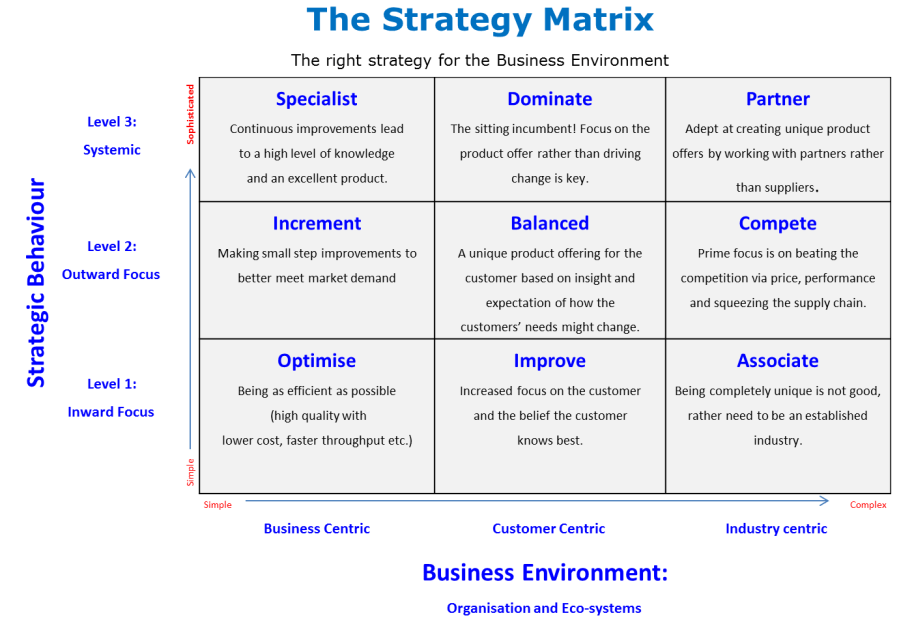
The organization is mapped from its most simplest to its most complex. The simplest is ‘Business’ centric company or group (within a company). It seeks to make itself better or more perfect. There is a natural tendency for a business to move laterally with time. It often requires a culture shift to move up through the levels.
 Cautley Consulting